
Zombie Attack in NYC
The Gothic Horror and Ressentiment of Class Consciousness

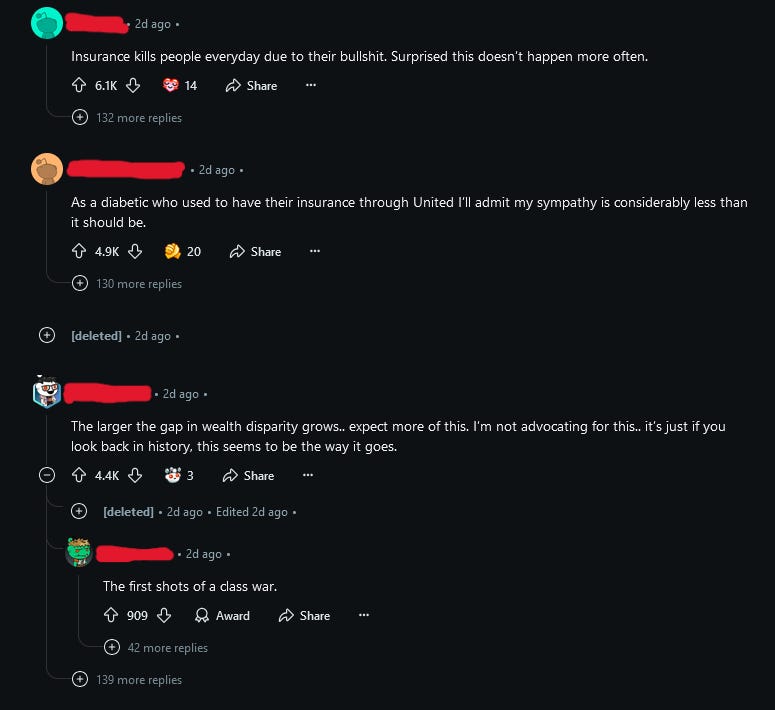
On December 4th, 2024, Brian Thompson, the CEO of UnitedHealthcare, was assassinated on the way to a company meeting in New York City. Considering the widespread criticism of the United States’ privatized health care system, it is no surprise that the public’s reaction to the assassination has been one of unbridled glee.
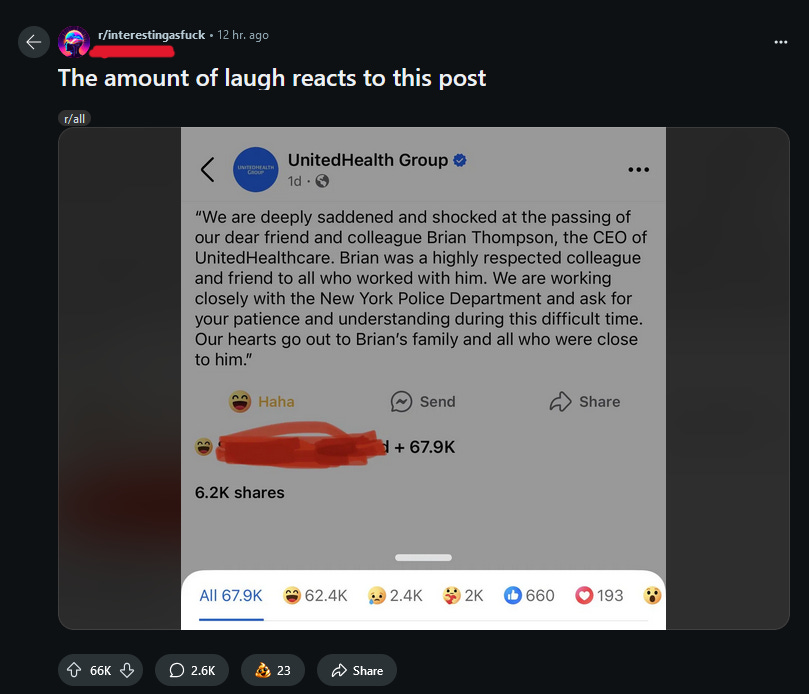
On various social media platforms reactions included puns such as ‘sympathy not being covered by the insurance network,’ laughing emojis, memes, and turgid, finger-tented pontifications on the first shots of a class war.
According to popular opinion, all CEOs should watch their backs.
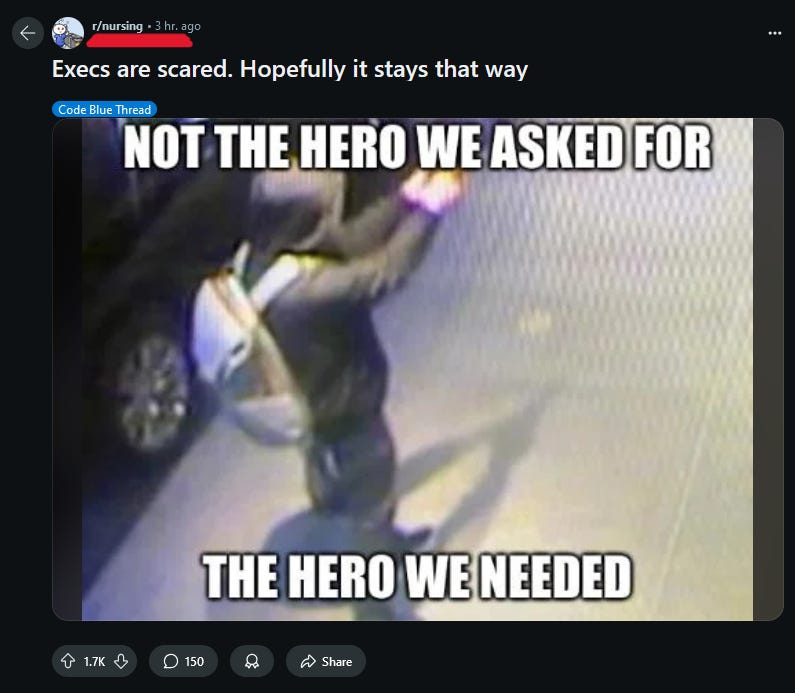
However, the saga of hooded rebels in combat against the suited-up empire is a Hollywood veneer. One which keeps the status quo afloat. The notion that there even exists a tangible and targetable enemy, wholly external and other to us, is the ultimate form of alienation from ourselves. Unlike the systemic oppression we might be able to see and feel every day, such an alienation stems from within.
What I am arguing is as follows:
The systems which oppress us are ultimately composed of our collective wishes. They are motivated by imagined states of existence in which our desires are met.
Very few of us even approach this ideal state of existence. Most are crushed under its inherent impossibility. But our perceived enemies do not work towards unrecognizable ends - we all share the same desires and ideals.
As a result, those who would dismantle the system are as equally integrated into it as those who would uphold it. Attacking such a system without recognizing our own complicity, assures the impossibility of transcending the limits of the world as it currently is.
The online reactions to Thompson’s murder are a consequence of a heavily-entrenched psychological resistance to introspection. They are structured by a ‘Gnostic’ tendency which ensures that we remain blind to the fact that the empire is in service to the rebellion, just as much as the rebellion is in service to the empire. Yet consider, conversely, this ‘Gothic’ description of capitalism, by Mark Fisher.
Perhaps more than most, Fisher knew that the greatest failure of social protest is the failure to recognize that one is always, in part, protesting against oneself:
“Capital is an abstract parasite, an insatiable vampire and zombie-maker; but the living flesh it converts into dead labour is ours, and the zombies it makes are us. There is a sense in which it simply is the case that the political elite are our servants; the miserable service they provide for us is to launder our libidos, to obligingly re-present for us our disavowed desires as if they had nothing to do with us.”
As a result of its Gothic mode, the injustices of late capitalist society are so abhorrent to us precisely because capitalism exists to confound the difference between the human and the monster, between desires we readily recognize as our own and the abstract ideals of efficiency which grind living human beings to a pulp in their gears. If we collectively aimed to sustain even a recognizable standard of living, would those gears grind to a halt with the death of every billionaire?
This explains much of the response to the assassination. Instead of recognizing our existence in an uncannily Gothic tale, one where the horror comes from what is most familiar, we latch on to narratives that frame our world through Gnostic allegories. Class consciousness is the light, pitted against the dark ignorance of an evil demiurge. Powerful, as it may be, evil incarnate can still be gunned down by enlightened beings. This dichotomy – of rebellion and empire, light and dark – maintains the failures of imagination which perpetuate the world as-is. Such a failure of imagination only leaves space for new gods and old gods, the mere transitions of dehumanizing power. There is no horizon for imagining the dissolution of the system into more humane and dignified organizations of society.
In this sense, the gleeful response to Thompson’s assassination is, at best, an indicator of the ambivalence we are trying to negotiate as we feel out and reject the horror inside of ourselves. To dehumanize the victim and valorize the murderer is precisely to reject the Gothic truth: that what we find most monstrous of all lies within us. For those of impoverished imagination, the illusory enlightenment facilitated by the ritual murder of our own ideals - our gods - is the sane option when the alternative is to confirm that our gods and monsters are one and the same.
Nietzsche described the situation best with his notion of ressentiment [resentment] and its ensuing inversion of morality from the perspective of the slave. Subjugated by the wealth, power, and cunning of the master, the slave is unable to imagine an emancipatory mode of being. As a consequence, the oppression and wretchedness of the slave are valorized as desirable markers of ‘goodness.’ Conversely, the power which oppresses is more than just ‘bad,’ it is metaphysically and irrevocably ‘evil’ in essence. Power is to be feared, and to fear is to be inherently good. Thus, power - the ability to inspire fear - is to be both evil and to be the predicate for the existence of goodness. According to Nietzsche, a society of slaves needs external agents of power – shadowy demiurges of oppression – to be their own underhanded co-conspirators.
In other words, the Gothic kernel of capitalism is that CEOs fulfill the desires of the masses by proxy.
As Fisher noted, those in power really are public servants, in the employ of the masses. They are the few among us who are perpetually at risk of being gunned down in exchange for the soothing narrative that there exists an evil that can be gunned down at all. Like witches at the black sabbath, they are an imagined false positive. The fantasy of the conniving CEO whose inhuman desires have no relation to out own, confirms the existence of an external and immutable principle of evil. It is a fantasy that rids us of any responsibility for our failures and consequently makes our unalterable discontent slightly more bearable.
Not to say that the downtrodden are solely to blame for their position. But neither are the wealthy. And each are complicit in the other’s existence.
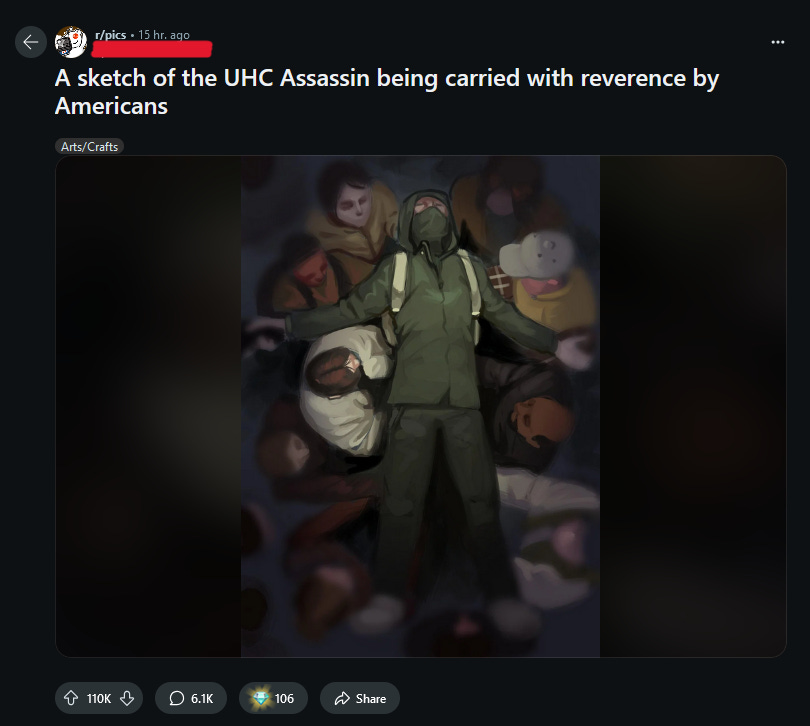
This is why the claim that the assassination is a unifying cry of class solidarity, bridging political divides, is as perverse as it is accurate.
The Gnostic light of class consciousness only glows under the brilliant and false demonization of the oppressor as the wholly other. It amounts to religious fervor in its rejection of the psychologically ambivalent realities of social organization. Class consciousness demands blind and irrational faith in the essential categories of good and evil as it eagerly, and with the utmost self-loathing, dismantles this world in order to accelerate the coming of a second one - just, perfect, and impossible.
What class consciousness, in this case, amounts to, is the concrete dismantling of politics, defined as the ability to imagine a future which is different than both the past and the present – to think otherwise. The subject of class identity crystallizes at the expense of political agency, at the expense of imagination, and at the expense of any possible future.
Political agency, as Fisher’s zombie analogy teaches us, emerges when we recognize our own desires in the other. So long as the other remains such, it serves merely to justify a subjugated existence and assure the impossibility of imagining it to be otherwise. The greed and dehumanization which Thompson, privatized healthcare, and the figure of the CEO all stand for, are not demonic forces stemming from ‘out there.’ They stem from ‘in here’ – in each one of us. Ultimately, to sustain this chasm between us and them is to sustain an alienated state, zombified and subservient to the parasitic hold of capital. To assail capitalism, as if it were an enemy ‘out there,’ is to assure a blindness and impotence to the parasite that remains ‘in here.’
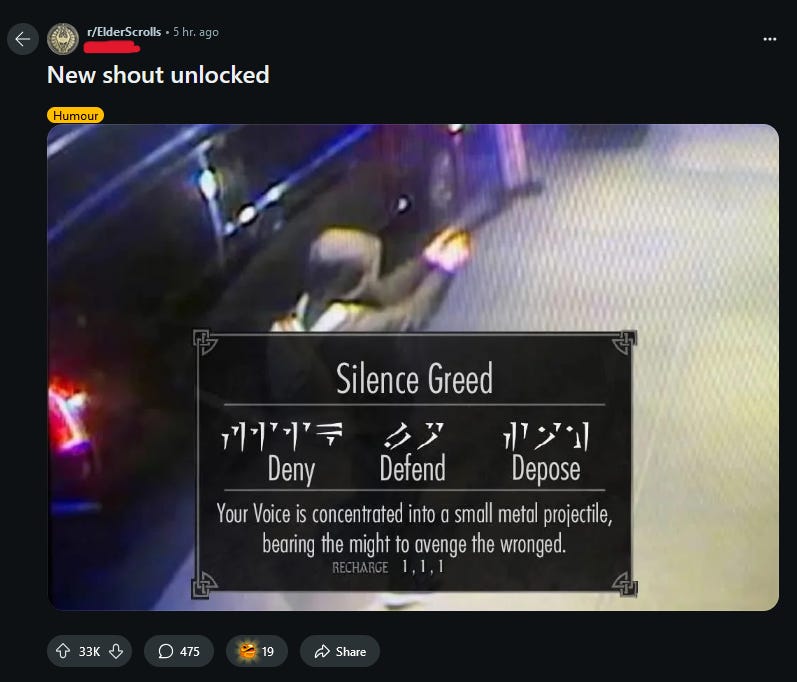
For the monster always escapes when it remains unrecognized. The monster always readies itself for the sequel when its true lair, the dark grottoes inside every one of us, are left undisturbed.
So long as CEOs like Brian Thompson are perceived as uniquely othered villains, as monsters and gods, the desires for which they are merely stand-ins will proliferate unchecked. Indeed, we will be convinced that we’re fighting the good fight, even as we enlist, arm, and orchestrate the maneuvers of our opponents.
Thompson is no metaphysical villain. But, just as the figure of the CEO holds extraordinary power in life, Thompson’s extraordinary death functions as a superspreader event for further eroding the imagination and agency of the masses. As they rabidly post, like, and re-post pacifying tales, each suckled thumbs-up frees them of the burden of thinking.
It’s not just zombies that eat brains.
Bibliography
Cohen, Jeffrey Jerome. 1996. “Monster Culture (Seven Theses)” in Monster Theory: Reading Culture. Ed. Jeffrey Jerome Cohen. Minneapolis: University of Minnesota Press.
Fisher, Mark. 2009. Capitalist Realism: Is There No Alternative? Winchester: Zero Books.
Nietzsche, Friedrich.2000 [1886]. “Beyond Good and Evil” in Basic Writings of Nietzsche. Trans. Walter Kaufmann. New York: The Modern Library.
Nietzsche, Friedrich.2000 [1887]. “On the Genealogy of Morals” in Basic Writings of Nietzsche. Trans. Walter Kaufmann. New York: The Modern Library.