
Rational, Demonic, and Divine
Osgood Perkins' Longlegs (2024)

“Satan has certainly been the best friend the church has ever had, as he has kept it in business all these years.”
- The Satanic Bible
Osgood Perkins’ Longlegs (2024) explores a kind of coercion which, although physically absent, permeates and saturates human life with the dread weight of authoritarian power. With every shot wide and perfectly centred, the film itself marks an absent figure of unquestionable authority – directing your vision. As a spectator, it is futile to resist looking anywhere but where you were always meant to look.
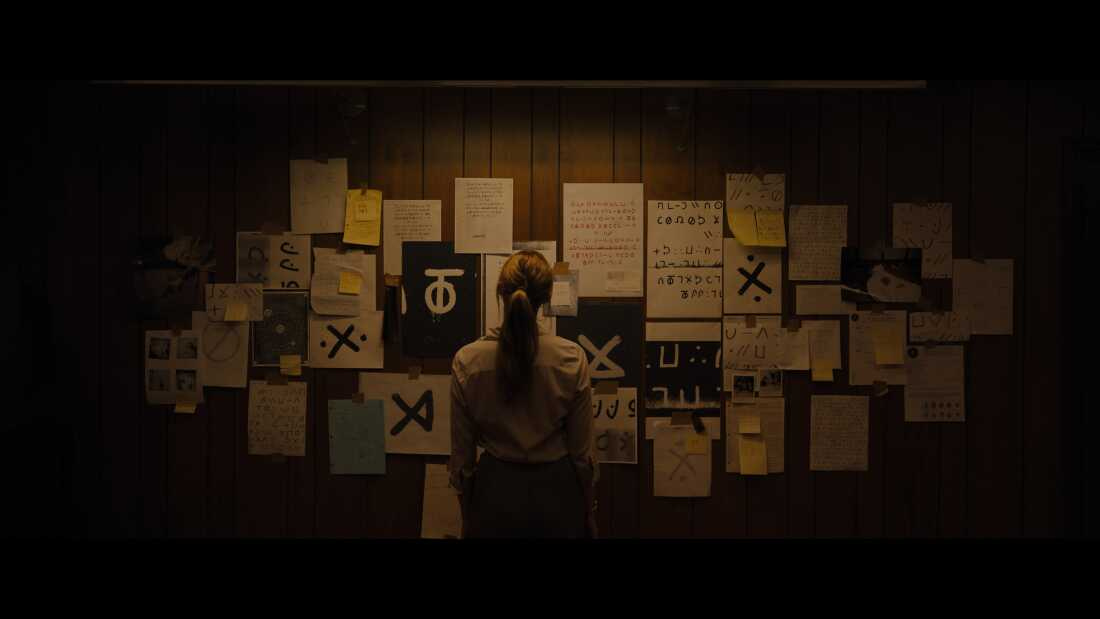
The plot follows an FBI agent, Lee Harker (Maika Monroe), who is on the trail of a serial killer known as Longlegs (Nicolas Cage). Curiously, Longlegs is never known to interact with his victim. Instead, families with young daughters are repeatedly slain in murder-suicides at the hands of the father. Only coded messages from Longlegs, who calls himself a friend of a friend, are found after the fact. In the film’s conclusion we discover that Longlegs, in the service of Satan, gift dolls resembling a family’s daughter which drive the fathers to violence. And indeed, Harker’s mother, in a bid to save her daughters life, has been assisting Longlegs in delivering these dolls.
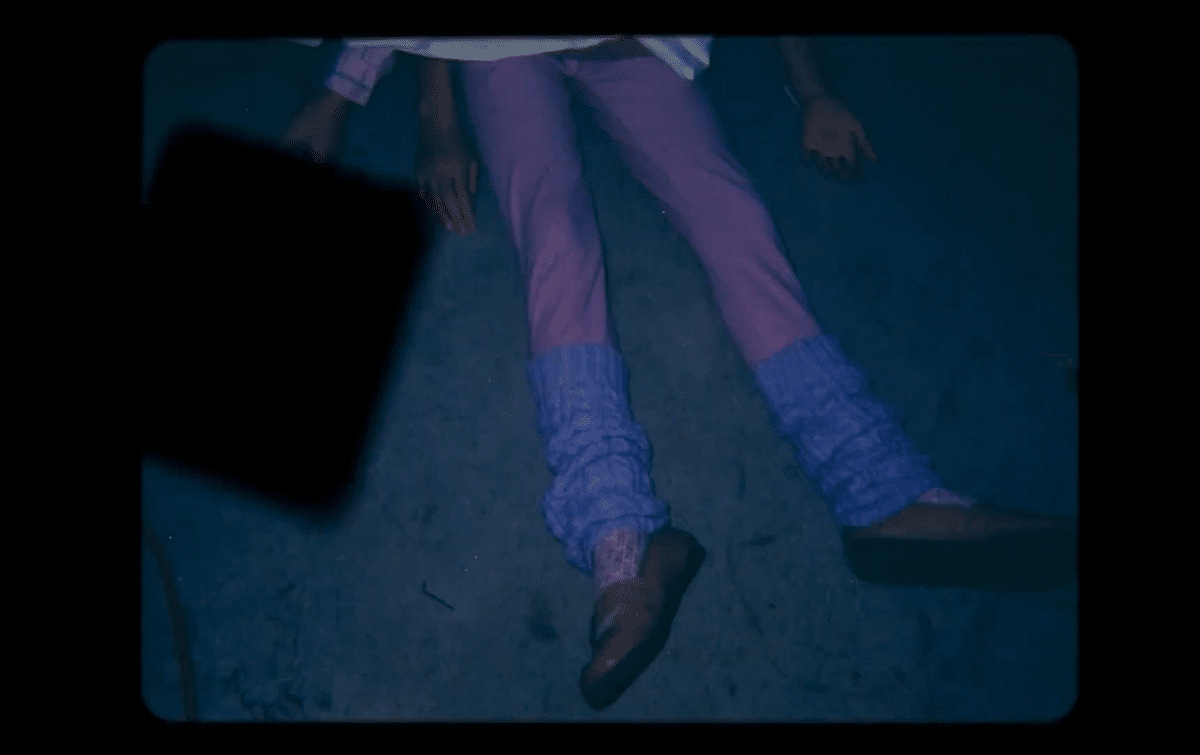
Images of authority proliferate throughout the film. They draw our attention to that quiet, physically absent, kind of power whose influence unfolds unnoticed. Reagan and Clinton peer out of picture frames adorning offices and homes. Christ’s image sags off of crucifixes. These little Xs mark the spot of yet other icons, symbols, and simulacra: dolls with the power to control their human doubles, yet whose heads are full of nothing.
As a film about spectral authority, Longlegs is also a film about the role of the family beyond childhood, extending into the process of negotiating one’s place in society at large.
Perhaps this is why Longlegs is a period piece, for more than aesthetic reasons. It tracks the changing role of the family in the latter half of the 20th century. It tracks the retinal afterimage of the nuclear family after it has disappeared from visibility, after it has imploded.
Only phantoms remain, though invisible their influence is still felt.
1. Mothers
In the first half of the 20th century, Max Horkheimer suggested that the dynamics of the nuclear family were undergoing significant changes. These changes had consequences for the dynamics of social relationships at large.
“The same economic changes which destroy the family bring about the danger of totalitarianism,” Horkheimer wrote. “The family in crisis produces the attitudes which predispose men for blind submission. As the family has largely ceased to exercise specific authority over its members, it has become a training ground for authority as such. The old dynamics of familial submission are still operative, but they make for an all-pervasive spirit of adjustment and authoritarian aggressiveness, rather than for a furtherance of the interests of the family and its members.”
The father, in an age where one’s identity is derived from adherence to mass ideals, is abstracted into institutions, collectives, and their ‘great’ leaders. The mother, left to care for the child at home, nevertheless must defer to rationalized ideals of mothering that are reified and enshrined outside of the individual family.
The mother must know ‘what to expect when she is expecting,’ she must automate the protocols of Dr. Spock’s handbook. Anything outside of the purview of rationalized mothering is pathologized – the result of a failed caretaker and/or a deviant child.
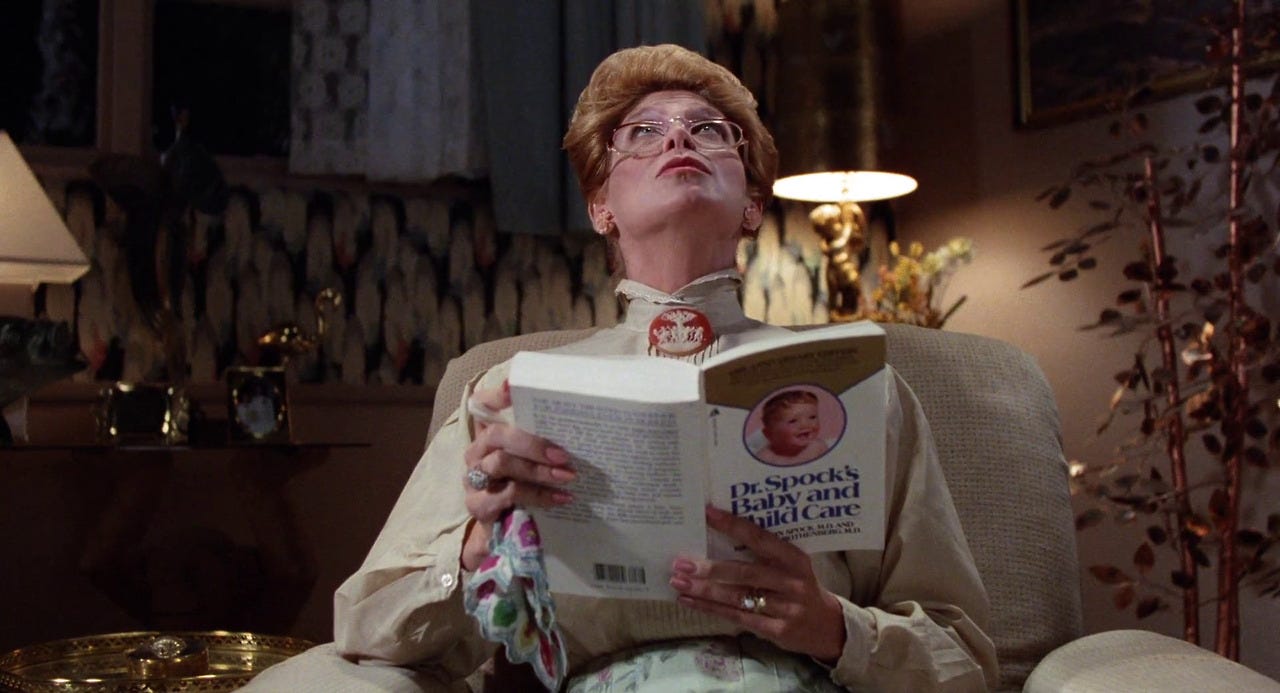
As a result of the child’s increasingly standardized encounter with the world, the child is robbed of the crucial mediation that the mother once performed. This mediation negotiated infantile, base desires and wishes with the demands of a harsh reality that left little room for play. Instead of being an intermediary – a facilitator of play in the face of frustrated impulses – a new kind of professional, rationalized mothering displaces the mother from an intermediate position between play and reality.
The mother is thus sapped of a crucially nourishing ambivalence and, as Horkheimer notes, the child abandons childhood early. Yet, perversely, childhood is nominally extended beyond all historical precedent. This results in long, liminal stages of adult-children – Dennis the Menace and Kevin McCallister, Lolita and Jodie Foster’s child-prostitute Iris. Yet the child-adults which these adult-children are pitted against, are testaments to the cancellation of further maturation. The adult world is no longer a strange negotiation of indulging in one’s desires and curbing them in order to maintain a socialized existence, but a regression – the erosion of society’s taboos and limits, an infinite expansion of childhood’s playground in response to a mothering that cancels all play.
Maturity is no longer an invisible, inner process of transmuting frustrated desires into the acceptance of self-restraint. Maturity is a visible, external process of putting on one’s long legs. Nothing more.
Indeed, as Longlegs’ opening scene clearly demonstrates, the name of the killer is merely his designation as ‘grown-up.’ When in the opening of the film, Longlegs meets the young Lee Harker, he stoops down to her height, apologizing for his choice of long legs that day.
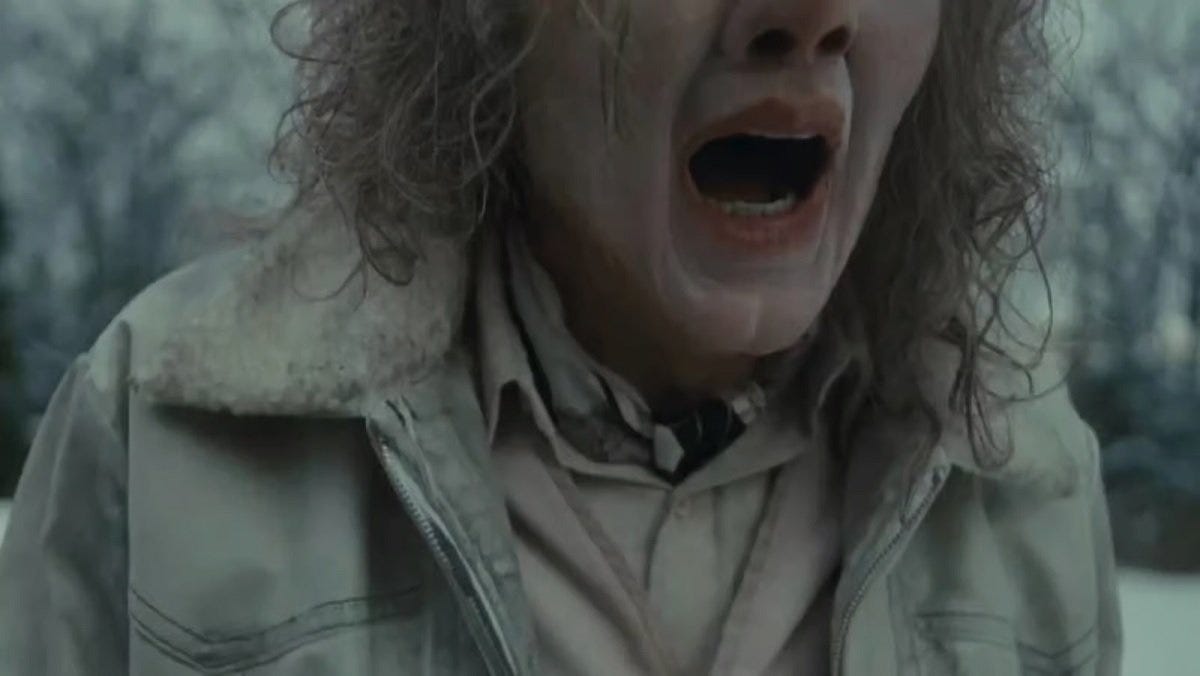
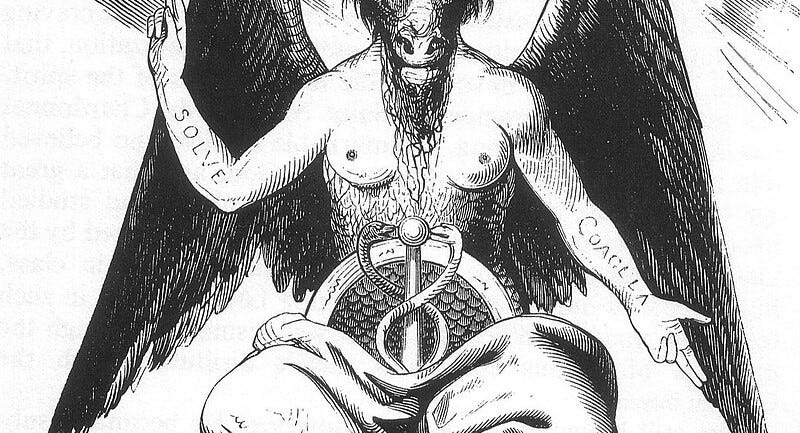
The choice of an androgynous, glam-rock image for Longlegs is also significant. As an adult, he embodies both parental figures – like the classic representations of Baphomet in Victorian occultism, with female breasts and male genitalia. This element is literalized when we discover that Harker’s mother had made a pact with the Devil to assist Longlegs and preserve Harker’s life.
Harker’s familial situation mimics the conditions of modernity. The father, subservient to an ideal, is not absent but merely sequestered away in the basement of the family home. The mother, colluding in sustaining these same ideals, rears the child with a calculating reason that justifies atrocity. Harker’s mother, through murder, allows her child to grow up. Deferring, as opposed to integrating and containing, an infanticidal ambivalence allows Harker’s mother to preserve her child while stunting her growth.
What results is a child who lives, but lives in a system where the orchestration of death is justified – “made right.”
As Horkheimer observed, the uniquely American matron – the “maudlin cult of the mother” – is far from a figure of nurture, far from a figure which can contain and hold a scrap of the child’s pleasurable wish to play, even as it explores a world of disappointments. “Rather,” Horkheimer wrote, “this cult is an ideological overcompensation for the abolition of the mother’s role. [...T]he ‘mom’ is the death mask of the mother.”
The overly-rational mother, who justifies the explosive realization of authoritarian atrocity in order to keep total societal collapse at bay, sustains a sacrifice for the sake of a diabolical civilization. Harker, who has been ‘allowed’ to grow her long legs, is really no more than an adult-child – frozen and incomplete in her ability to navigate an imperfect, less-than-ideal world.
This is also how atrocity becomes viral. It needs to be enacted again and again, ritualistically, methodically, and rationally – a parental sacrifice for the sake of society.
This is why, as Harker is warned, Longlegs – ‘Mr. Downstairs’ – is found inside everyone and down from everywhere. Everyone grows up askew in contemporary society. Everyone makes a pact to put on their long legs, but only when expedient. Only when they have to resurface. Because, having never really grown into maturity, everyone stays downstairs anyway.
2. Fathers
Subjecting religion to a psychological critique, Sigmund Freud argued that religious beliefs functioned as a consolation, an illusory way of thinking about the world which responded to unbearable existential anxieties.
He elaborated, moreover, that the psychological origins of religious ideas are partially located in universal childhood encounters with authority – the father/parental figures who curb the unbridled desires of the child for the sake of a civilizing self-preservation. These figures of authority are internalized as a form of self-restrain: a conscious. But they are also externalized, in an idealized and unattainable form, into the impersonal forces of nature.
We do not grow out of the wrath of these forces, unlike the threats of the father we outgrow in childhood. They threaten our lives everyday, with little semblance of control. Hence, we imagine and fantasize their personification. We attribute to their terror, the same terror we felt under the thumb of familial authority.
In a sense, the notion of a diabolical world – a world in which senseless tragedy, aggression, and violence are the work of sinister, invisible powers – is desirable. As Freud wrote, in such a world “we can breathe freely, can feel at home in the uncanny and can deal by psychical means with our senseless anxiety.” Indeed, we can try to negotiate, make appeals to, and enter into contracts with the personalized form of our fears, just as we could with the parental authority we faced as children.
Most importantly, however, Freud argues that the projection of internalized authorities, as deities and demons, is a means of preserving the wish that we, ourselves could aspire to such power. We, ourselves, as beings that are partially spirit, could one day grow into the figures which terrified us as children.
This is the allure of spirit – the allure of the demonic just as much as it is the appeal of the divine. And this allure sustains a failure of maturity – a failure to recognize an infantile reflection of the parent’s awesome sublimity in the images we project of gods and devils.
In Longlegs, Harker’s mother is complicit in Longlegs’ murders – housing him in her basement – and, unlike the unfortunate targetted families, enters into an agreement with her patriarch, Satan. Unlike the fathers and mothers who act on violence, Harker’s mother enters a contract precisely because she cannot bear to even hold psychic responsibility for any ambivalence felt for her daughter.
Birthdays, as indicated by Harker’s mother’s mocking tone, are evil days for ambivalent parents. And, as we see in the flashbacks to the Camera family murders, it is not that Satanic forces possess fathers and mothers to act unlike themselves, but that Satanic forces allow them to act on what they already are.
The doll, as an exact replica, a simulacrum of the child, is a zone of play in which parents can enact their already contained aggression. Mother Camera laments her painful C-section, stabbing her doll-daughter in return. Father Camera takes up the axe he uses for cattle, and makes meat of his spouse.
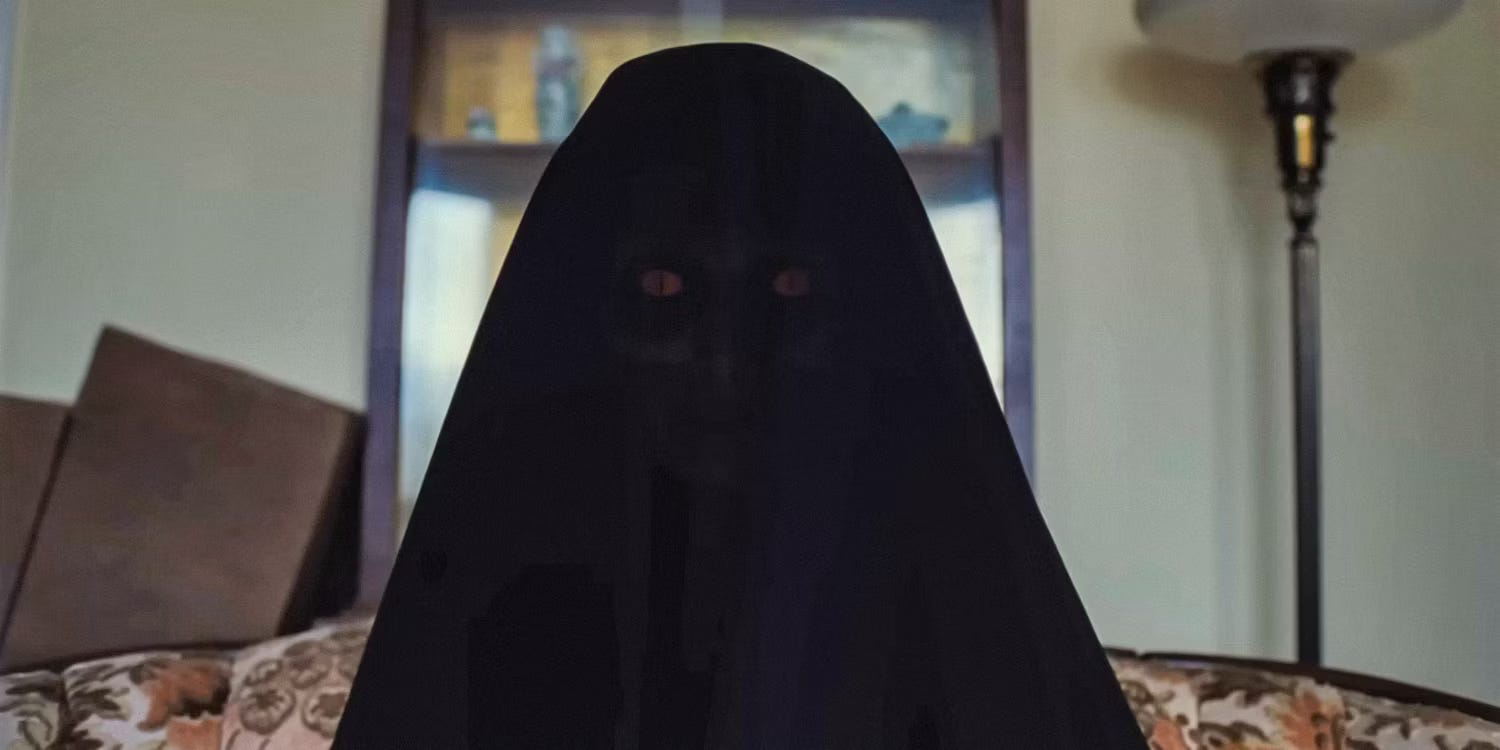
The doll is a transitional proxy, a site through which the negotiating work of play ensures that unconscious impulses are not acknowledged and then stayed, but indulged and then enacted. The dolls that Longlegs makes are, as he states, the dark; they contain nothing.
The dolls are not possessed by demonic forces when they enter family homes. They are meant to be possessed by whatever already resides (under) there.
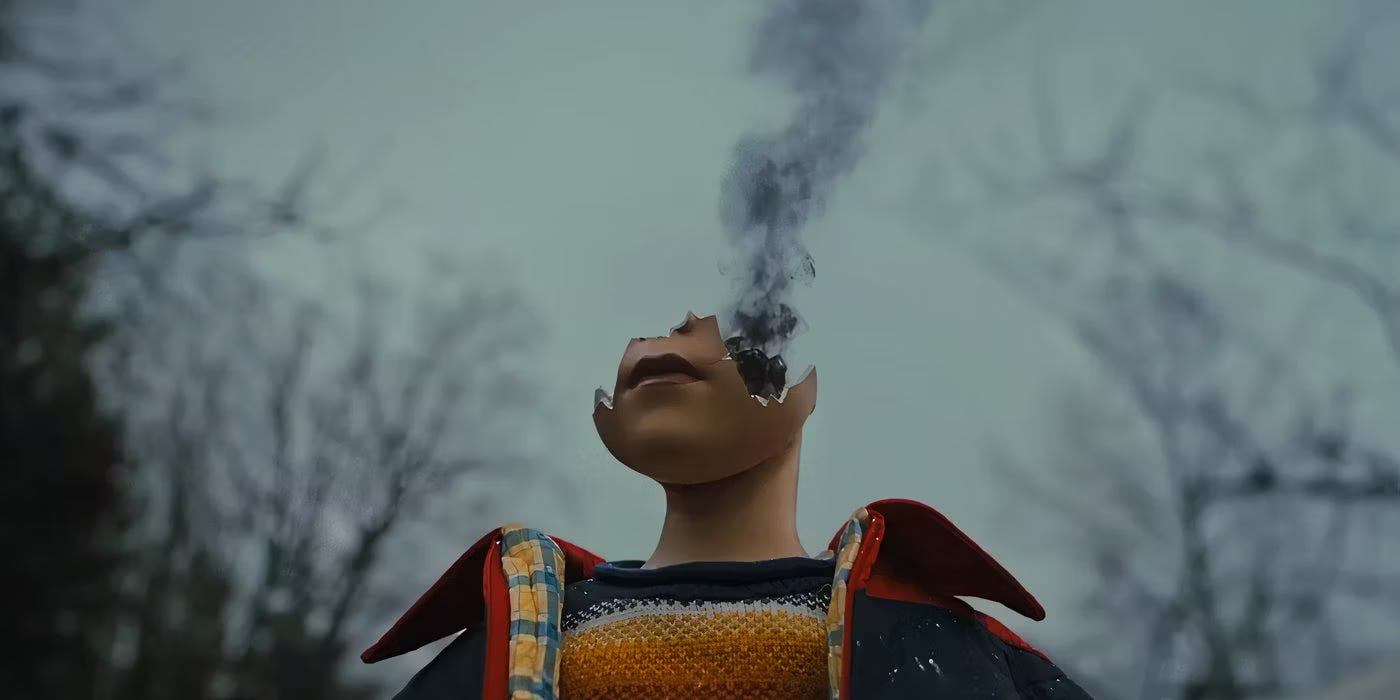
Harker’s mother’s Satanic pact and the Camera family’s possession, however, embody two poles of immaturity. Harker’s mother does not enact the violent urges she feels towards her daughter, but defers responsibility for them to an external personalization of her own ambivalence – to Satan. The fathers who murder their wives and children, however, enact their hostility.
Both, however, are unable to contain their incompatible emotions alone. Both of these poles are a failure of maturation, a failure to contain violence which is either posited as an inevitability in the world or enacted by oneself.
Religion, as we see in the contrast between Harker’s complicit mother and the homicidal fathers, is indeed a stepping-stone towards a more socialized and less brutal existence. Yet it nevertheless remains the symptom of a collective emotional illness.
Religion is a degree of civilizing mastery over our own wild passions. A means to exist in an already-fallen world, and thus resist the impulse to fell it oneself at every frustrated, disappointed, and unmet need. Yet religion is not humanity’s psychic cure, only its palliative care.
3. Gods
Longlegs is, ultimately, a film which explores the vast, collective family which humanity imagines for itself in order to preserve a scrap of sanity.
Such a family preserves the dialectical necessity of both the divine and the demonic. A world governed by Satan is better than a world governed by nothing at all – that is, a world with no hope of a personified good and no consolation that a personification of evil can be adjured.
As Harker’s partner warns her throughout their investigation, there is such a thing as looking “too long” at evil. Looking too long can be tantamount to growing up too much – which is equated with not growing up at all.
As Horkheimer wrote on religion, “dissatisfaction with earthly destiny is the strongest motive for acceptance of a transcendental being. If justice resides with God, then it is not to be found in the same measure in the world.” Looking too long at the world’s injustices only folds back into a nauseous impulse to eject any trace of culpability from oneself – to project it outside, onto a concrete other than can be known, pinned down, and fully to blame.
At the end of the film, evil remains – Satan’s power ensures Harker’s gun won’t fire, although it should. And alongside evil remains the illusory ideal of what Horkheimer called “perfect justice.” If Satan has power, he can be the target of retribution and conquest. “Religion,” Horkheimer wrote, “is the record of the wishes, desires, and accusations of countless generations” – it remembers what one would like to forget, in order to imagine a world in which wrong is made right.
Such a world, a world with even the possibility of perfect justice, is a fantasy. Which is not to say that justice is impossible, merely imperfect. The history of injustice, coercion, and atrocity is never erased, is always borne by future generations. In that sense, Mr. Downstairs is not downstairs just from everywhere. He is everywhere and everyone, in part.

This is the perverse illusion of religious thinking. The idea of evil is given both more and less power than in reality. It is imagined to be both naturally and intrinsically everywhere, yet not in everyone. In this way does the overly-optimistic illusion of a perfect justice become a means of interpersonal control – societal and familial. This illusion coerces you to obey the ‘good’ father, in order to overcome the ‘bad.’ But it is an optical illusion which obscures the ultimate collapse of good and bad authority into one ambivalent figure.
Instead of a measured internalization of authority – full of both care and terror – we split a conscience found within from a Satanic temptation encroaching from without. Frozen in this limbo, unable to carry the burden of an imperfect existence, every adult is merely a sporadic longlegs.
Bibliography
Freud, Sigmund. [1927] 2001. “The Future of an Illusion” in The Standard Edition of the Complete Psychological Works of Sigmund Freud. Trans. & ed. James Strachey. London: Vintage. 5-56.
Horkheimer, Max. [1935] 1972. “Thoughts on Religion” in Critical Theory: Selected Essays. Trans. Matthew J. O’Connell. New York: Continuum. 129-131.
Horkheimer, Max. 1949. “Authoritarianism and the Family Today” in The Family: Its Function and Destiny. Ed. Ruth Nanda Ashen. New York: Harper & Brothers. 359-374.
Lavey, Anton Szandor. 1969. The Satanic Bible. New York: Avon Books.
Filmography
Perkins, Osgood. 2024. Longlegs. New York: Neon.