
Brat Brat
Thoughts on Doubling in a Moment and an Era

In his 1919 essay on the uncanny, Freud recounted a personal experience. While on a train journey, a particularly violent bump in the tracks swung his compartment door open. Freud found himself unexpectedly confronting an intruder; an old man in a dressing gown and night cap whose appearance he “thoroughly disliked.” Before he could eject the man from his compartment, Freud realized that he had, in fact, misrecognized his own reflection in a full-length mirror revealed by the opened door.
For Freud, the uncanny constitutes an encounter with estrangement. The ‘thorough dislike’ that Freud felt towards his own, aged reflection is, in this sense, produced by the tension of maintaining two incompatible ideas. To confront one’s double hearkens back to a universal, infantile wish for eternal life. Although often associated with feelings of fear and displeasure, Freud thus asserts that the uncanny amounts to a confrontation with initially pleasurable desires. These desires have not only gone unmet but have been given up under the compulsion of reality and its limits.
An impossible striving for permanence has been a prominent theme throughout Charli XCX’s Brat period, culminating in Aidan Zamiri’s The Moment (2026). The film – appropriately timed to coincide with Charli XCX’s Brat follow-up, a tie-in album for Emerald Fennell’s Wuthering Heights (2026) – is presented as a ‘mockumentary’ or even fictionalized 2024 ‘period piece.’
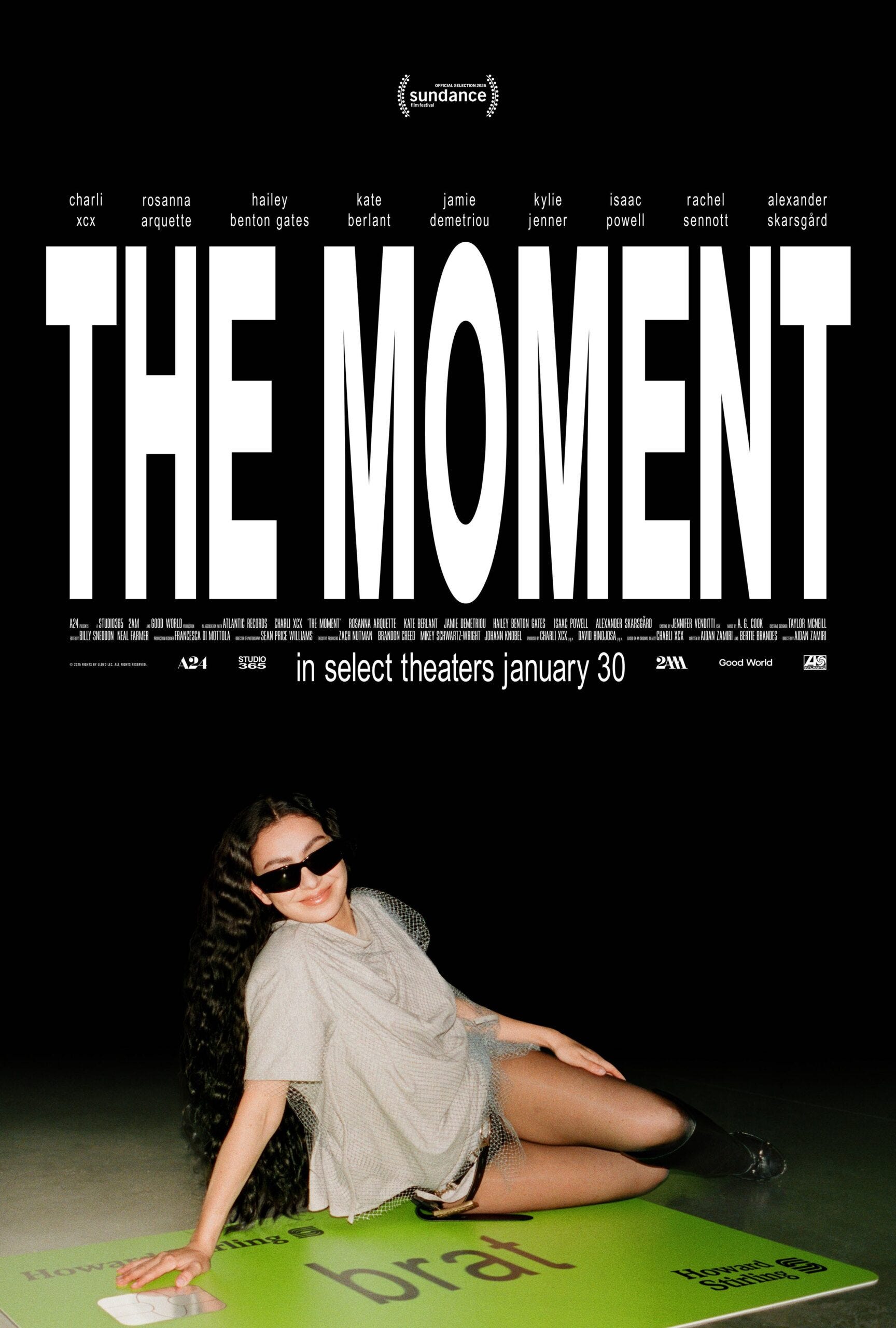
The Moment estranges the pop cultural experience of Brat, depicting the lead-up to a tour initially tethered in reality, before it is inverted into something distinctly uncanny. Backup dancers and bedazzled, showgirl-style costumes come to occupy the stage. Strobe lights are replaced by programmed light bracelets worn by each audience member. Backdrops and banners feature an unfamiliar shade of ‘brat green,’ displaying a newly Rent-ified logo, stylized as a graffiti-template, complete with high-school yearbook-style doodles.
In a pivotal scene of the film, Charli, exhausted by the conflicting, doubled demands of her label and personal creative team, retreats to a luxury hotel in Ibiza. The hotel offers a striking contrast to the industrial rehearsal space where much of the film is set. Whereas the rehearsal space is a black void, densely populated at its centre by Charli’s crew, the hotel unfolds into an expansive horizon of glass and water. Yet the hotel is also empty and vacant, silent like a cloister. And whereas The Moment itself produces an uncanny double of 2024’s Brat rollout, it is here where Charli confronts her physical double: Kylie Jenner (played by Kylie Jenner).
Brat is, of course, an album thoroughly haunted by the uncertainty of doubling (girl, so confusing…). There are apples that don’t fall far from the tree, Lorde, Taylor Swift, and, of course, Charli herself. Or, rather, the relationship between an artist’s creative process and the end result: the work of art.
Kylie’s role as doppelgänger is telegraphed in advance, featured in the music video for A.G. Cook’s “Residue,” from The Moment’s soundtrack. In the video, the camera begins by following Charli through a series of hallways before her route is intercepted by several seemingly identical figures. Each successive double is followed before they collectively congregate in a warehouse, not unlike The Moment’s rehearsal space. Initially arranged in a grid-like formation, the Charlis devolve into a frantic dance before only one – revealed to be Kylie – remains.
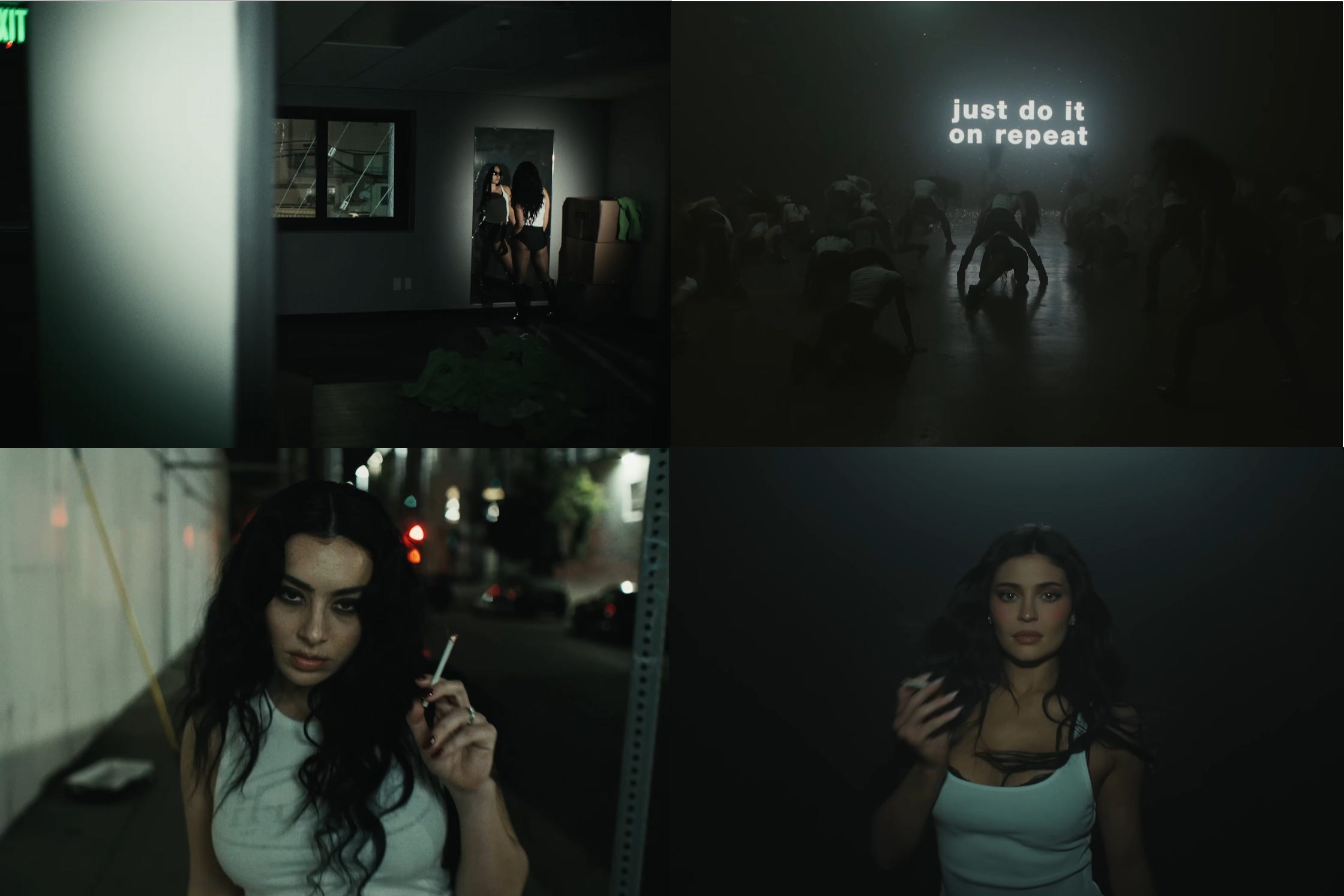
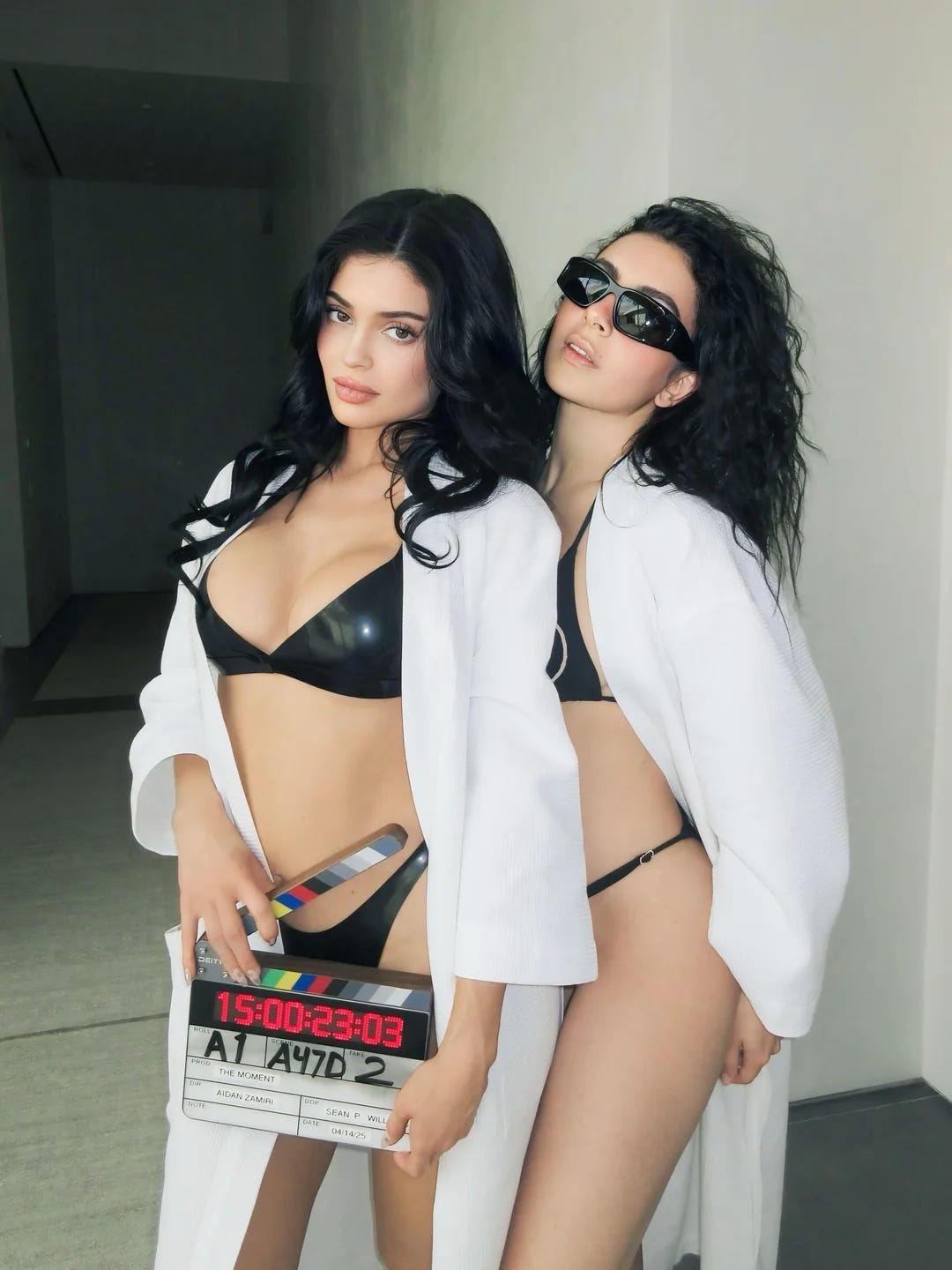
Not unlike the music video, when Charli meets Kylie at the hotel spa in the film, they are not only equals – both celebrities at an exclusive resort – but literally rendered equivalent to one another. Like ascetics, both women wear identical robes, towels, and sandals, each dons the uniform of standardized leisure. Indeed, Charli’s vacation – her retreat and withdrawal from the world – is itself scheduled by her assistants and employees in the same way that her workday is regulated by demands of her employers. The uncanniness of the encounter with Kylie arises from a confrontation with a wish to externalize and immortalize a piece of oneself, as art, that has been surmounted by the realistic imperative to produce art that is lucrative – equivalent to an anticipated standard.
Just before Charli encounters Kylie, she is denied service by the resort’s highly sought-after beautician, for being too stressed to ‘work with,’ for having a skin type that’s just aging ‘wrong,’ for not being open to having children or practicing enough ‘self care’ – accusations which sound more like Charli has failed to maintain a car, than her own body. Like Freud’s experience on the train, the encounter between Charli and Kylie doesn’t highlight the horror of impermanence. Instead, it highlights the horror of realizing the unconscious persistence of the wish for permanence. The extent to which Charli performs the self-love of producing ‘art’ and undertaking ‘relaxation’ are both, in The Moment, tethered to financial consequences which have already commodified, made fungible, and, thus, rendered equivalent both the artist’s leisure and labour – their ‘life’s work’ and the act of its devourance by another.
If all art simultaneously expresses a vestigial wish for immortalizing the artist, the act of creation is also the persistent disappointment of this wish. Art, of course, is not the artist, nor is art permanent. It is a realistic, socially acceptable compensation for the otherwise delusional wish to make a life, or even a single moment, last forever.
In this way Freud’s uncanny – the re-engagement with a long-disappointed wish – is a fundamental dimension of art. And the impulse to create art is, in this way, also deeply cringe. Charli’s persona has long leaned into this quality (“I don’t give a fuck what you think about me, what you think about me, so, yeah, fuck you”). Brat summer, brat autumn, brat winter, brat spring. By changing all of her album covers to resemble Brat on streaming platforms, Charli ensured that even when you weren’t listening to Brat, you sort of still were.
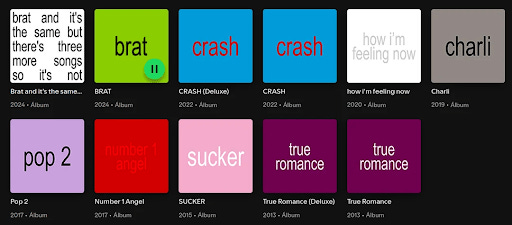
In this sense, Brat had always aimed for oversaturation, adjusting itself to an increasingly disposable world where all aspects of human life are susceptible to scheduled programming. If Mark Fisher’s analysis of ‘capitalist realism’ finds it to perpetuate the myth that exploitative conditions can last forever, then with every forced update and subscription renewal we confront the reality that ‘nothing’ is precisely the only thing that can last forever. In fact, ‘nothing’ is all one can ever own to begin with.
Inflected in the iconography of Y2K, indie-sleaze, and Dimes Square, Brat appeared to embrace the very disposability that it implicitly resisted. As a work of art, Brat was not only mechanically reproduced, standardized and streamed on every phone with a data plan, but was also multiplied – as audio file, music video, remix, meme, slogan, and film. The nature of art, as the artificial extension of the artist, was itself artificially extended to the mass through standardized forms of their participation – a monotonous tone, ethic, and vibe. In response to the inflexible cultural feed of late capitalism, Brat seemed to say that given enough diffusion, oversaturation, and re-iteration, art reduced to nothing might become something after all.
Both Brat and its reiteration in The Moment engage in reversing art’s relationship to commodification: if art is a confrontation with the transience of life, what does art accomplish when it sets the artificial perpetuation of life as its primary task?
As Charli suggests, reflecting on the nature of Brat in “The Death of Cool,” what makes art ‘cool’ is its ability to generate a community – a matrix through which more art, more culture, more life might be made – beyond the limited space of the museum, the concert hall, or the duration of an album’s shelf life. Even at its most commercial, art that expands the scope of life itself avoids the charge of being ‘bad’ art or, even worse, a commodity – which is to say, not art at all.
Charli echoes a very familiar position of Walter Benjamin’s in which the cult or ritual value of art is contrasted from its exhibition value. Instead of the imperative to reach the highest number of spectators, the cult value of art is derived from the limited and final nature of the work in time and space. Before the advent of the public as a homogenous mass, before the development of photography and mechanical reproduction, before the Mona Lisa was a fridge magnet, sticker, or JPEG file, art demanded that spectators congregate for a limited time in a limited space. As Benjamin argues, it is precisely this limited temporality through which art can facilitate an experience that endures outside, in other domains of communal life, and which no one spectator could have received in solitude.
For Benjamin, of course, this is the famous ‘aura’ generated by art – itself an object generated from raw materials that resemble nothing of the final product. Art is more than what is presented within the frame, precisely because art serves a continuously generative social function. This aura is what is lost in the ability to mechanically produce and distribute the image. The photograph, in the 19th century, models the mass commodification of culture throughout the 20th century and into the digital age.
Yet Benjamin intuited that, much as the work of art facilitated the bonds of a community, the work of mass culture could facilitate a fracture and break with a community: that is to say, revolution. If standardized culture was the consequence of increasingly standardized life, such a culture might also facilitate a potential collective – i.e. standardized – resistance to commodification.
Which brings us, finally, to The Moment’s implicit double. A film about producing a performance in 2024 is inevitably haunted by that same year’s highest-grossing tour of all time: Taylor Swift’s Eras Tour. Caught between Broadway spectacle and Vegas revue, the Eras Tour is distinctly devoid of nostalgia. Compartmentalized by ‘era,’ each show finds Swift cataloging a career retrospective which renders each moment of her body of work – spanning three decades, and a wide range of cultural relevance and reception – equivalent to one another and, most importantly, immanent. The past – history itself, so to speak – is sampled by Swift as if it were present.
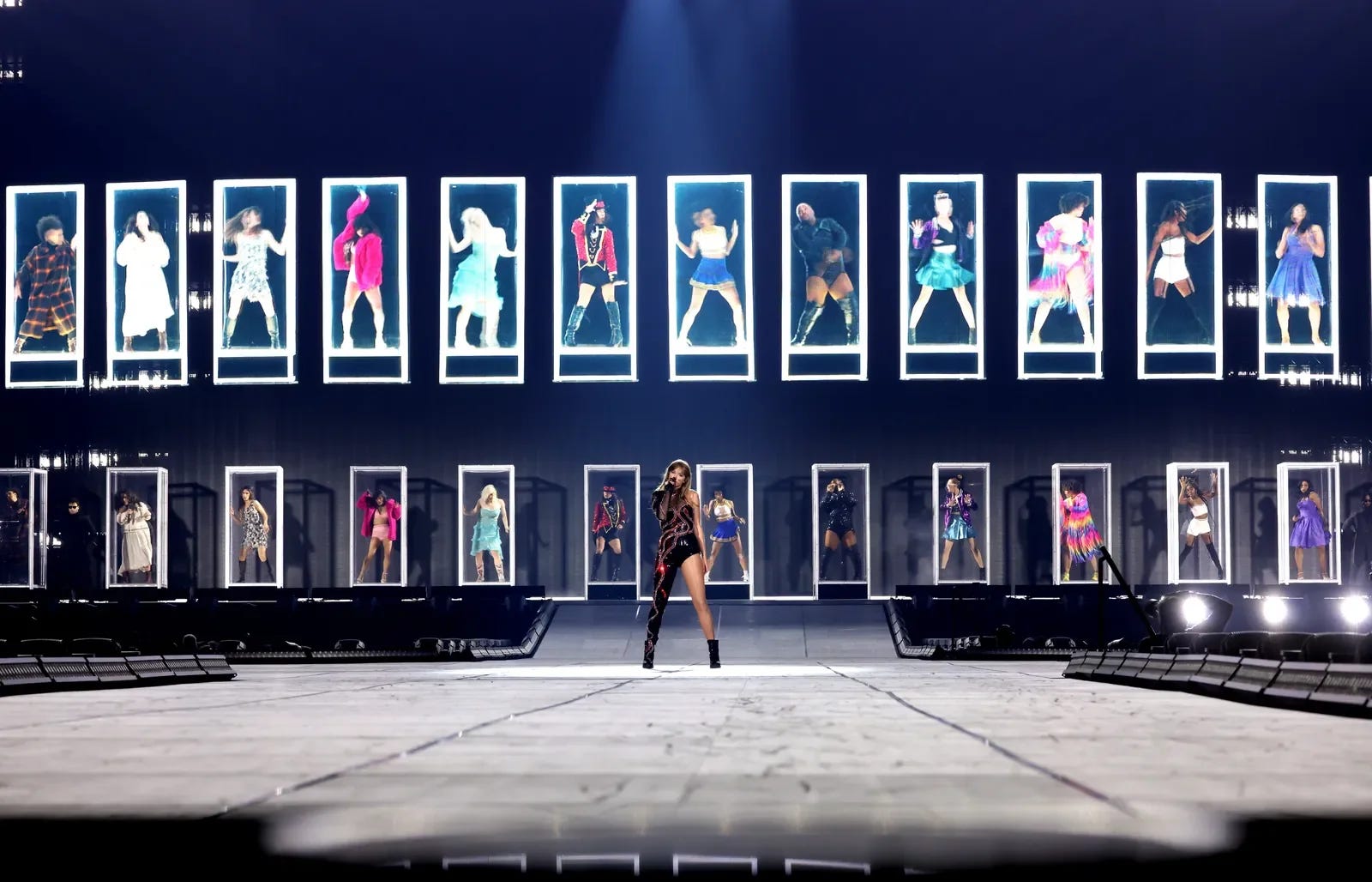
In a choreographed sequence for the Reputation-era track, “Look What You Made Me Do,” each back-up dancer embodies one of Swift’s eras while trapped in a glass box. This duplication is paralleled in the “Residue” video where it is clear that the essence of Charli’s ‘Brat era’ is an aesthetic and an ethic which, instead of raging against the glass cage of homogeneity, is meant to be lived through the mass (any one individual can dissolve into the regiment of ‘365 party girls’).
Swift’s eras, conversely, work towards superficially negating the homogenization of mass art. On the one hand, Charli’s Brat uniform (white top, black bottom, dark shades, and a shock of hair) can be embodied by each and every consumer, just as easily as a throng of thousands can singularly don a brat-green tee. On the other hand, the outfits worn by an Eras audience embody a diversity that belies the maintenance of its implicit homogeneity. Each era leads back to the artist as singular personality, visionary, and genius, over any one work of art. Each Eras concert has ‘a lot going on at the moment,’ to quote Swift’s Red era (a complement to Charli’s Brat-green).
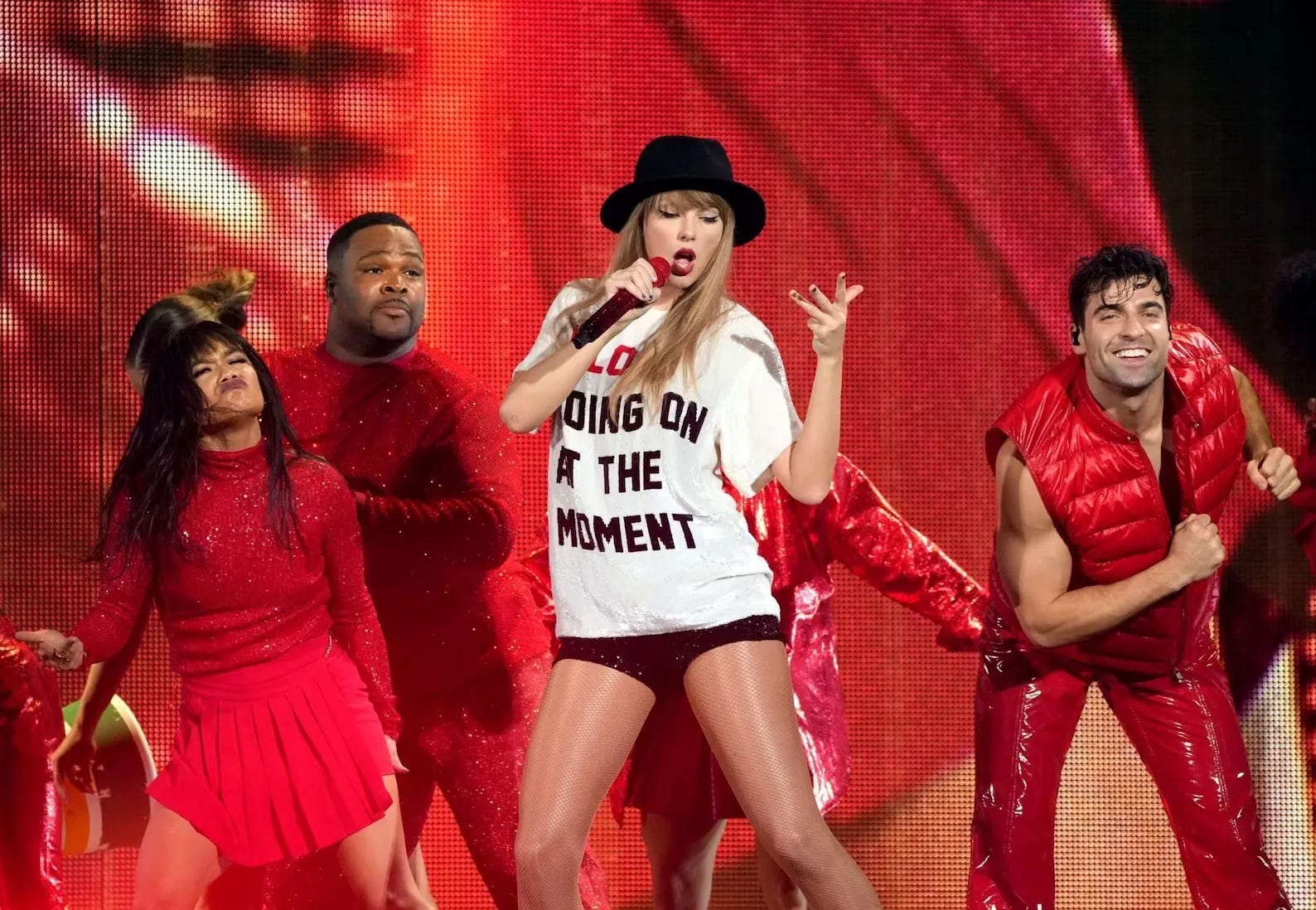
Ultimately, there is a significant difference between enshrining a succession of moments as stable eras to be iterated and reiterated, and the homogenization of one era, the moment beyond its moment. Which is to say, there is a difference between art as the inscription of history and art as the consumption of history – or, to return to Benjamin, between art maintaining and making a community, and art revolutionizing and unmaking a community.
Even though the impulse to make art is always tethered to an impossible task – i.e. the elimination of transience – art, itself, is always disposable. Brat inevitably indulges alien desires, facilitating a homogenous conduit for the interests of capital and commodity to worm themselves into the deepest crevices of leisure and freedom. Perhaps in doing so, Brat models a cultural space in which transience can be tolerated, even when it emerges out of the desire for permanence.
The effectiveness of Charli’s album, film, and moment will ultimately be seen in the permanence of their ephemerality. The uncanniness of one era, doubled, is always also an invitation to double again. With enough doubling, the original self-immolates: burning Brat. And with the eradication of life’s double, the model and standard for conforming to the mass, what is left to limit life’s horizon?
Your Favourite Reference
Benjamin, Walter. [1955] 2019. “The Work of Art in the Age of Mechanical Reproduction” in Illuminations. Trans. Harry Zohn. Boston: Mariner Books. 166-195.
Charli XCX. 2025. “The Death of Cool” in A Rabbit’s Foot, 13: 94-95.
Fisher, Mark. [2009] 2022. Capitalist Realism: Is There No Alternative? Winchester: Zero Books.
Freud, Sigmund. [1919] 2001. “The Uncanny” in The Standard Edition of the Complete Psychological Works of Sigmund Freud. Vol. XVII. Trans. & ed. James Strachey. London: Vintage. 219-256.
Zamiri, Aidan. 2026. The Moment. New York: A24.
omg writing something very similar now, more so with a Baudrillard lens, excited to quote u